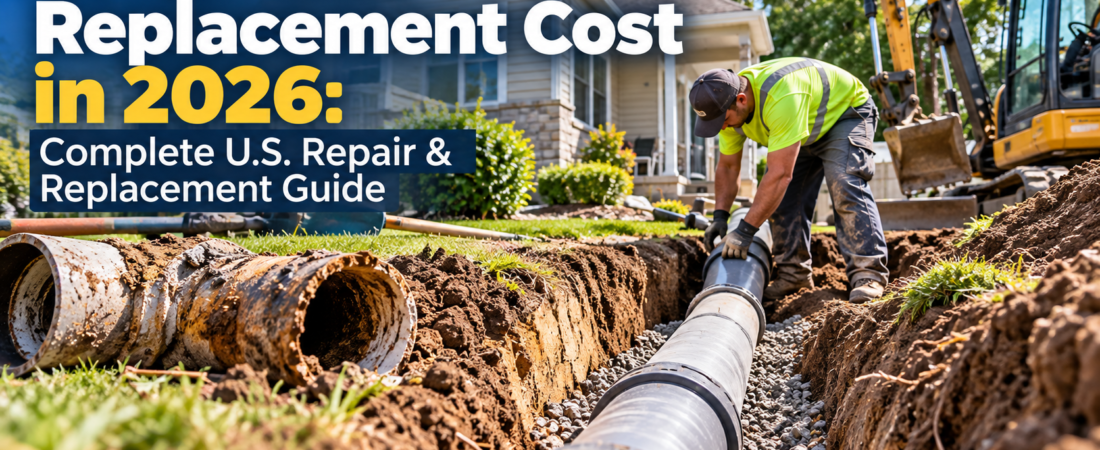
Few home-repair problems feel as urgent as trouble with the main sewer line.
What begins as slow drainage can progress into repeated clogs, sewage backup, or a failed underground pipe. Roots, corrosion, soil movement, age, and poor installation can all contribute to failure.
The difficulty for homeowners is that sewer problems often require decisions before they fully understand what is underground.
In 2026, sewer-line replacement averages approximately $3,319 nationally, while many professional projects fall between about $1,388 and $5,323. Difficult replacements can move toward or beyond $10,000, particularly where the line is long, deep, buried beneath pavement, or requires major site restoration. (homeadvisor.com)
2026 Sewer Cost Overview
| Project | 2026 Planning Cost |
|---|---|
| Average sewer-line replacement | ~$3,319 |
| Common replacement range | $1,388–$5,323 |
| Sewer repair | $1,100–$4,100 |
| New sewer pipe installed | ~$50–$250 per linear ft. |
| Trenchless lining project | $1,900–$6,000 |
| Camera inspection | ~$175–$500 |
| Major cleanup after backup | Can reach thousands |
Pricing depends on pipe length, depth, site access, material condition, repair method, and how much of the property has to be restored afterward. (angi.com)
What Is the Main Sewer Line?
Every home has smaller drains carrying wastewater away from:
- sinks
- showers
- toilets
- bathtubs
- dishwashers
- washing machines
Those lines eventually connect into a larger pipe.
In properties tied into a municipal sewer system, that main line typically runs from the house toward the public connection.
Responsibility for the line is not the same everywhere.
Some municipalities place more responsibility on the homeowner than others, including portions close to the street.
If ownership is unclear, contact the local wastewater utility before approving a large repair.
Common Reasons Sewer Lines Fail
Tree Roots
Roots grow toward moisture.
Once they find a crack or joint, they can enter the line, restrict flow, and worsen existing defects.
Removing roots may restore operation temporarily, but repeated intrusion can indicate that the pipe itself needs repair.
Aging Materials
Older U.S. homes can contain:
- clay
- cast iron
- Orangeburg
- older concrete products
Age does not automatically mean the line has failed, but older materials may eventually crack, deform, corrode, or collapse.
Soil Movement
Settlement, erosion, and ground movement can shift underground piping.
A section that once drained correctly can develop a low spot where wastewater collects.
Corrosion
Metal pipe can deteriorate internally.
As the pipe wall weakens, the interior can become rougher and the structure less reliable.
Installation Problems
Premature failure can result from:
- incorrect slope
- weak joints
- insufficient support
- inappropriate materials
- poor connections
- movement after installation
Warning Signs
Possible signs of a main-line problem include:
- more than one drain backing up;
- repeated sewer clogs;
- toilets gurgling;
- sewage odors;
- unusually wet or green patches in the yard;
- wastewater appearing in low fixtures;
- backups that occur when another fixture drains.
A single slow sink is not automatically evidence of a failed sewer main.
Problems affecting several fixtures at the same time are more concerning.
Why Camera Inspection Is So Valuable
Before digging up the yard, homeowners should understand what the contractor is trying to fix.
A sewer camera can reveal:
- root intrusion
- damaged joints
- offsets
- cracks
- collapsed sections
- corrosion
- standing water
- blockages
Current camera-inspection pricing is typically a few hundred dollars, with current guides placing many inspections in the $175 to $500 range. (angi.com)
Ask whether the service includes:
- video
- still images
- line locating
- depth information
- written findings
If a contractor recommends complete replacement, you should understand what evidence supports that recommendation.
Cost Per Linear Foot
A useful current national range for professionally installed replacement sewer pipe is roughly $50 to $250 per linear foot, with some project data averaging around $150 per foot. (angi.com)
The wide range exists because pipe replacement beneath a lawn is very different from pipe replacement beneath:
- concrete
- driveways
- landscaping
- retaining walls
- trees
- decks
- roads
Often, the expense is not the pipe itself.
The expensive part is reaching it and restoring everything afterward.
Traditional Excavation
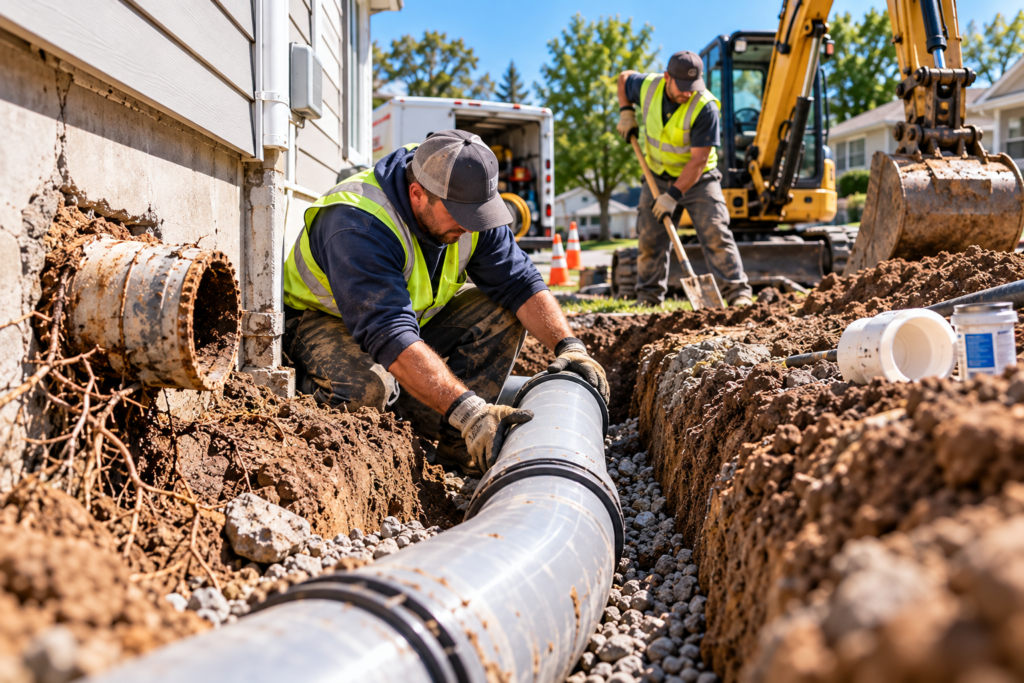
Traditional sewer replacement involves digging down to the pipe.
The damaged line is exposed, removed or bypassed, and replaced.
This approach can make sense when:
- the pipe has collapsed;
- severe deterioration affects large sections;
- the alignment needs to change;
- trenchless methods are not practical;
- excavation is already required.
The downside is property damage.
A trench may affect:
- lawn
- fences
- irrigation
- landscaping
- pavement
- walkways
The plumbing invoice may therefore represent only part of the final cost.
Trenchless Sewer Replacement
Trenchless systems attempt to reduce surface disturbance.
Two common approaches are pipe lining and pipe bursting.
Pipe Lining
A liner is installed through the existing pipe, creating a new interior pathway.
Pipe Bursting
A new pipe is pulled through the old route while the existing pipe is broken or displaced.
These methods are not appropriate for every situation.
Severely collapsed or badly misaligned lines may still need excavation.
Current 2026 data places many trenchless lining jobs around $1,900 to $6,000, depending on length, pipe condition, and access. (angi.com)
Is Trenchless Work Automatically Cheaper?
No.
The specialized plumbing itself can cost more in some cases.
However, it may avoid expensive restoration such as:
- replacing a driveway
- pouring new concrete
- rebuilding landscaping
- repairing lawn areas
- major excavation
Compare the total cost of the complete project, not only the plumbing portion.
A $5,000 trenchless job that preserves a driveway can potentially be more economical than a cheaper excavation followed by several thousand dollars of restoration.
Hidden Costs That Can Change the Budget
Yard Restoration
After excavation, the homeowner may need:
- grading
- topsoil
- sod
- seed
- irrigation repairs
- replacement landscaping
Driveways
A line beneath asphalt or concrete can add a major secondary project.
Sidewalks
Depending on location, private or public walkway restoration may be required.
Interior Cleanup
Sewage entering the home can create expenses for:
- contaminated material removal
- disinfection
- drying
- flooring
- drywall
- odor control
Current estimates show that serious sewer cleanup can reach thousands of dollars. (angi.com)
Permits
Some municipalities require both permits and inspection.
Certain trenchless projects can involve permit costs approaching $1,000, although requirements vary significantly by location. (angi.com)
When Repair May Be Enough
Not every damaged pipe needs complete replacement.
A localized repair may make sense when:
- the defect affects a short section;
- most of the line is still sound;
- one joint has failed;
- root intrusion is limited;
- there is a single isolated crack.
Replacement becomes more reasonable when:
- deterioration exists throughout the line;
- several failures are present;
- parts of the pipe have collapsed;
- repairs are becoming repetitive and expensive;
- overall material condition is poor.
Ask the contractor whether the proposal is for a spot repair, partial replacement, or full replacement.
Example Sewer Budget
Consider a homeowner with a damaged line under the front yard.
Possible costs:
Camera inspection: $350
Pipe replacement: $4,500
Permit: $300
Excavation/site work: included
Landscaping restoration: $1,000
Irrigation repair: $400
Contingency: $650
Possible total: $7,200
This is only a sample budget.
The important point is that the plumbing quote may not include everything required to return the property to normal condition.
Insurance Questions
Homeowners insurance does not automatically pay for an old sewer line.
Coverage can depend on:
- cause of damage
- policy exclusions
- maintenance
- sudden covered events
- sewer-backup endorsements
- optional service-line coverage
Some insurers offer additional service-line endorsements.
Check the actual policy rather than relying on another homeowner’s experience.
Questions to Ask a Sewer Contractor
Before approving a large job, ask:
- What did the camera show?
- Can I see the recording?
- How deep is the pipe?
- Where is the failure?
- How many feet need work?
- Why is this method recommended?
- Could trenchless work?
- Are permits included?
- Is excavation included?
- Who restores the yard?
- Is pavement repair included?
- What warranty applies?
- Is cleanup included?
Even when a sewer problem feels urgent, you can still ask for a clear explanation of what is being proposed.
Reducing the Cost
Start with diagnosis before excavation.
For major non-emergency replacements, consider a second opinion.
Ask whether a partial repair is realistic.
Compare trenchless and traditional approaches.
And consider obtaining separate restoration bids for landscaping or concrete if the plumbing contractor is subcontracting that work.
When Sewage Backup Becomes an Emergency
Sewage in occupied areas should be treated seriously.
Wastewater can contain harmful microorganisms.
Avoid direct contact, keep pets and children away, stop unnecessary water use, and contact an appropriate professional.
Do not continue flushing toilets or running appliances if that increases the backup.
Frequently Asked Questions
What does sewer-line replacement cost in 2026?
Current national data places the average around $3,319, with many replacements falling between $1,388 and $5,323. (homeadvisor.com)
What is the cost per foot?
A broad current installed range is about $50 to $250 per linear foot. (angi.com)
What does trenchless sewer work cost?
Many current pipe-lining projects fall between roughly $1,900 and $6,000. (angi.com)
Should I pay for a camera inspection first?
For repeated sewer problems or a major replacement recommendation, viewing the condition of the pipe can provide useful evidence before excavation.
Do tree roots always mean replacement?
No. The correct solution depends on how they entered the pipe and the condition of the line.
Who is responsible for the sewer lateral?
That depends on local municipal rules. Contact the sewer authority for the property.
Final Thoughts
Sewer replacement becomes expensive because the line is buried.
A realistic total may include:
- diagnosis
- pipe
- labor
- excavation
- trenchless equipment
- permits
- pavement restoration
- landscaping
- cleanup
The current national average is around $3,319, but complicated properties can cost significantly more. (angi.com)
The strongest approach is to inspect the line, identify the exact failure, compare appropriate repair methods, and include restoration in the budget from the start.
HomeCostPilot Note: Prices are informational U.S. planning estimates. Local contractor rates, utility rules, permits, property conditions and pipe configuration can materially change actual costs.